
Summary
A sedentary lifestyle at work represents a major health challenge today, exposing employees to cardio-metabolic risks, type 2 diabetes and mental health problems.
To combat this problem effectively, the most successful companies adopt a global approach: internal policies favoring active breaks and standing meetings, layouts with active furniture, and above all, individual motivation schemes based on personalized objectives and regular follow-up.
Among these solutions, well-designed pedometer competitions stand out for their proven effectiveness. Thanks to progressive objectives, team dynamics, motivating rankings and personalized coaching, they significantly increase daily steps while improving overall well-being.
OuiLive responds to this need by offering a rapid, turnkey launch of 100% mobile challenges, with over 200 templates, dynamic rankings, varied challenges and precise analytics to drive yourengagement KPIs.
Contents :
- Why a sedentary workplace is a priority issue
- The reference framework: PNNS, Santé publique France and recommendations
- Which interventions work in the office?
- A pedometer competition to combat sedentary lifestyles at work?
- Proven method: setting up a pedometer competition that (really) works
- Best practices for a differentiating pedometer competition
- Why choose OuiLive for your step challenge?
- FAQ : Sedentary lifestyles at work & pedometer competitions
Why a sedentary workplace is a priority issue
Sedentary behaviour is defined as low energy expenditure (≤ 1.5 METs) in a seated or lying position (excluding sleep). In the workplace, it is exploding: adults spend very long hours a day sitting, especially on working days.
Consequences:
- increased mortality risk,
- cardiovascular disease,
- of certain cancers,
- type 2 diabetes,
- anxiety,
- depression.
Conversely, frequently interrupting sitting time with active micro-pauses has beneficial effects.
Telecommuting can accentuate prolonged episodes of sitting, making it all the more urgent to take action in the workplace and at home. For companies, this is an issue of public health, performance and QHCT.
The reference framework: PNNS, Santé publique France and recommendations
Reducing physical inactivity is a public health issue supported by Santé Publique France and integrated into the French National Nutrition and Health Program (PNNS). International recommendations emphasize both increasing physical activity and reducing prolonged sitting times.
Which interventions work in the office?
The literature identifies three complementary levers for combating sedentary lifestyles in the workplace:
- Company policy: managerial support, ambassadors, stand-up meetings, active break slots, QVCT framing.
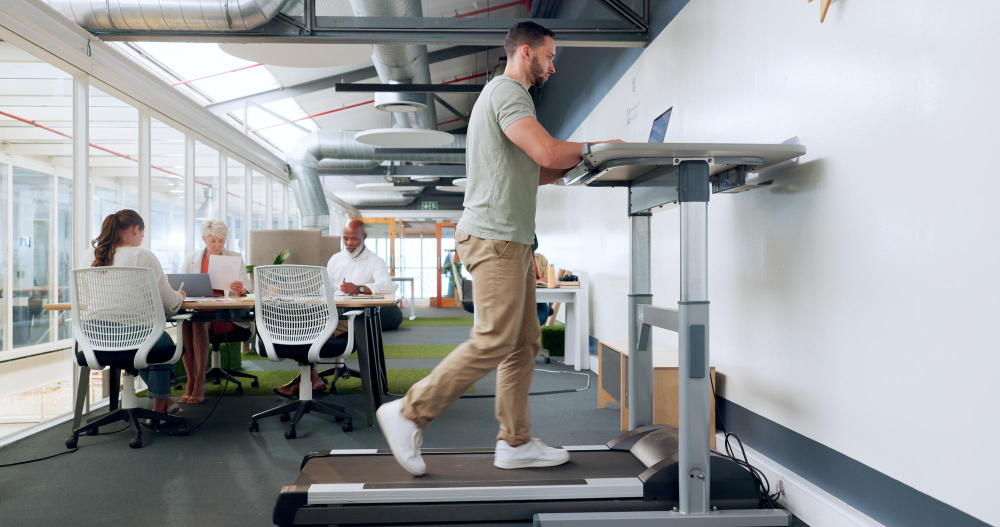
- Environment: "active furniture" (sit-stand desks, pedalboards, treadmills) and layouts that encourage standing and movement.
- Information & motivation: education, displays, reminders to turn off the seat, self-monitoring of behavior (step counter), personalized goals and regular feedback.
Active furniture is a particularly effective lever. A sit-stand workstation can significantly reduce sitting time and increase standing time over the course of the day. But it's the combination of all three levers that maximizes the impact.

A pedometer competition to combat sedentary lifestyles at work?
Programs supported by a step counter (smartphone or tracker) are associated with significant increases in daily steps, especially when they incorporate behavior change techniques (goals, self-monitoring, feedback, social reinforcement).
Proven method: setting up a pedometer competition that (really) works
1) Framing (Week 0-1)
- Objectives: reduce sedentary behaviour (e.g. -10% of time spent sitting during the day), increase activity (e.g. +1,500 steps per day on average).
- Targets & scope: all functions (offices, teleworking), sites and languages.
- Governance: executive sponsor, project committee (occupational health, internal communication, QWL).
- Facilities: validated pedometers/apps, active furniture in key areas, planned active breaks.
2) Challenge design (Week 2-3)
- Format: 4 to 8 weeks (progressive, tiered), teams for emulation.
- Mechanics: personalized objectives, rankings, daily/weekly challenges, symbolic rewards.
- Intelligent reminders: notifications to interrupt long periods of sitting (e.g. 5 min/30 min, 10 min/hour, or at least every 2 hours).
- Accessibility: low-tech options (manual declaration) and tracker integrations.
3) Launch & animation (Week 4-11)
- Inspiring kick-offs (public health issues, PNNS message), active break guides, visuals in the workplace ("Stand up for the team point", "Walk-call").
- Managerial ambassadors: exemplarity (stand-up meetings), inter-team micro-challenges.
- Real-time feedback & analytics: step progress, participation rate, estimated energy expenditure,engagement heatmaps.
4) Consolidation (Week 12+)
- Assessment (engagement KPIs), feedback, permanent facilities (sit-stand desks, pedal cycles, dynamic break areas).
- Integration into routine: "standing meeting" days, official active breaks, "walking-1:1".
Best practices for a differentiating pedometer competition
- Clear rules: achievable targets (e.g. +10% per week versus baseline), bonuses for interrupting sitting time (logged microbreaks).
- Equity & inclusion: relative objectives, adapted career paths (return from leave, medical constraints).
- Intelligent gamification: rankings, badges, customized rewards (charitable donations, low-carbon goodies).
- Useful communication (activity promotion): "energy, concentration, mental health" benefits.
- Serious measurement: baseline (7 days), weekly follow-up, before/after comparison, 3-month consolidation.
- Data protection: transparency on team aggregates, no sensitive individuals.
- PNNS & QVCT alignment: clear benchmarks and official resources.
Why choose OuiLive for your step challenge?
OuiLive transforms your HR, occupational health, internal communications and CSR challenges into 100% mobile entertainment experiences that really engage.
- Quick, turnkey launch: intuitive interface, +200 templates, dedicated support (configuration, content, managerial sponsoring).
- Gamified platform: rankings, challenges, rewards, educational content (PNNS, Santé publique France).
- Measurement & impact: advanced analyticsengagement, average steps, micro-pauses, participation), exports for your QVCT/RSE reporting.
- Scalability: from pilot (1 department) to multi-site deployment (FR/International), compatible with hybrid work environment (face-to-face and teleworking).
FAQ : Sedentary lifestyles at work & pedometer competitions
- How much sitting time is a problem?
The risk rises sharply with longer periods of sitting, especially for less active people. Frequent sitting reduces the risk.
- Is a step challenge enough on its own?
It's an excellent trigger. The best results come from a mix of policy (active breaks), environment (active furniture) and motivation tools (goals, reminders, self-monitoring).
- What should I look out for when taking a break?
Ideally, aim for 5 minutes every 30 minutes or 10 minutes per hour of movement; at the very least, get up for a few minutes every 2 hours.
Sources :
1. Santé publique France - Sédentarité au travail: des interventions efficaces existent. Read the article
2. CMVRH - Ministère de la Transition écologique - Sedentary lifestyles in the workplace: a challenge. Go to page