
We've all heard "you need to take 10,000 steps a day".
Is this a golden rule or an urban legend? What does science have to say? And above all: how can you transform this objective into a 100% mobile challenge that boosts the cohesion, health and performance of your teams? Deciphering, proving and operational instructions for launching your walking challenge with OuiLive.
Contents :
- 10,000 steps, myth, useful landmark... what does science have to say?
- Benefits of walking: cardio, metabolism and mental health
- Tailor targets to specific target groups (young, working, 60+)
- 10,000 steps on the job: why it's powerful
- The 10,000-step Challenge with OuiLive: instructions for use
- Practical tips for "walking more" at the office (and elsewhere)
- FAQ : The questions your employees ask
- Why choose OuiLive for your 10,000-step challenge?
10,000 steps, myth, useful landmark... what does science have to say?
The origin of the "10,000 steps" is not an official medical recommendation, but a marketing benchmark popularized in Japan in the 1960s. The media and the sports world then helped to establish it as a universal goal. It's a good motivating target... without being a rigid medical prescription.
The World Health Organization (WHO) guidelines don't talk about steps, but about duration of activity: 150 to 300 minutes of moderate-intensity physical activity per week for adults, with a key message: any activity is better than none, and the more you move, the better.
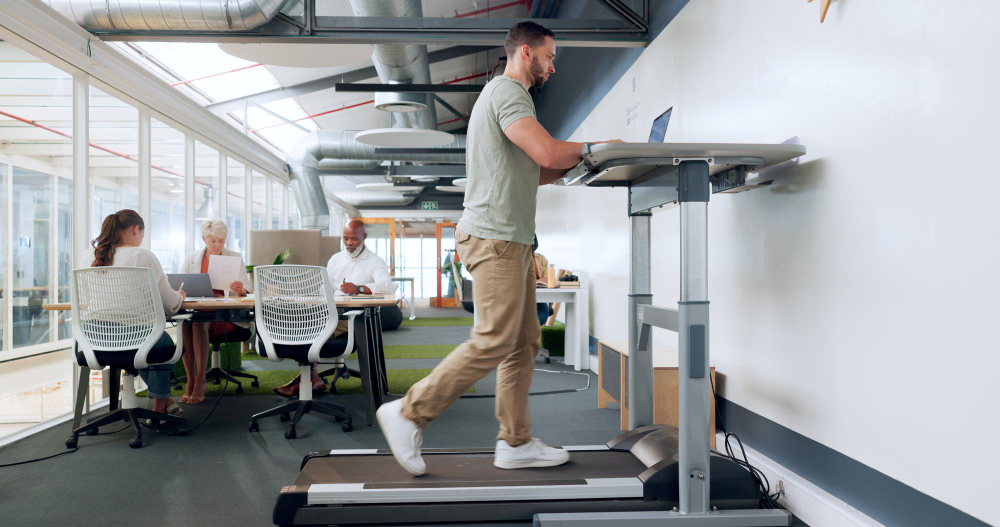
In terms of steps per day, several recent studies show a dose-response relationship: the more you walk, the greater the reduction in the risk of mortality and cardiovascular disease, with benefit thresholds as low as 4,000-7,000 steps per day, depending on age and state of health. In people aged 60 and over, aiming for 6,000 to 9,000 steps a day is already associated with a 40-50% lower risk of cardiovascular events.
For your internal communications:
- The 10,000 steps are a simple, motivating target (easy to measure, easy to display in rankings).
- The benefits go well beyond that: every 1,000 extra steps count, especially for sedentary employees.
Benefits of walking: cardio, metabolism and mental health
Putting physical activity at the heart of a QHCT policy is not just a fad. Regular walking (or more sustained walking sessions) has an effect on :
- cardiovascular markers (blood pressure, lipid profile) and risk of cardiovascular disease;
- metabolism (weight, blood sugar), useful for a gentle return to sport;
- mental health (stress, mood, sleep) ;
- reducing the risk of long-term non-communicable diseases.
Concrete benchmarks: 10,000 steps ≈ 7.5 km and ~300-400 kcal expended (order of magnitude), with a time that varies according to pace: around 1 h to 1 h 40 for a sustained daily walk.
Tailor targets to specific target groups (young, working, 60+)
- New walkers/sedentary: start at 4,000 - 6,000 steps, increasing in increments of 500-1,000 steps per week.
- Active: aim for 7,000-10,000 steps, add running if desired.
- 60 and over: 6,000-9,000 steps already bring substantial gains, with no pressure to "do 10,000".
Key HR message: there's no magic number "you have" to reach. The real victory is progress and consistency.
10,000 steps on the job: why it's powerful
- Clear, universal and inclusive objective: Everyone can "walk 10,000 steps", even without sophisticated equipment. It's fair and accessible.
- Strong participation via mobile: A 100% mobile format stimulates participation: real-time steps, rankings, challenges and rewards.
- QVCT & CSR impact: Less sedentary lifestyle = improved well-being and prevention. The walking challenge can be linked to a cause for societal impact.
- Measurable KPIs: registration rates, accumulated steps, minutes of activity, challenges completed: all analytics for real-time control.

The 10,000-step Challenge with OuiLive: instructions for use
OuiLive is "Business in game mode": a platform for corporate mobile games with +200 ready-to-use templates, rankings, challenges, rewards, and a launch in just a few minutes, perfect for a walking challenge. Here's a concrete framework (to be adapted to your corporate culture):
1) Setting up the experiment (2 weeks before)
- Objective: to increase the average step size by 20% compared with week 1, and achieve an 80% active rate.
- Scope: individuals and teams (sites, BUs, countries).
- Rules: all types of physical activity taken into account (walking, hiking, running).
- Accessibility: manual mode for employees without a compatible watch/phone.
2) Onboarding (J-7 → J0)
- Visual teasing and snack-content (FAQ "how many steps a day?", "how to take 10,000 steps without realizing it?").
- In-app tutorials: connect your meter, join your team.
- Internal ambassadors: 1 per team to lead group walking sessions (lunch break, end of day).
3) Game design (3-6 weeks)
- Daily quests: "+500 steps after 8 p.m.", "A walking meeting", "Climb the stairs".
- Weekly challenges: "pair walking challenge", "beat your personal record", "weekend nature trail".
- Rankings: individual, team, inter-site, weighted to avoid penalizing beginners.
- Rewards: prize draws in increments (e.g. 5,000/7,500/10,000 steps; more inclusive).
- Educational content: capsules on the benefits of walking, mental health and sleep, WHO mini-quiz.
4) Measurement & ROI
In OuiLive, track: adoption (registrations, weekly actives), intensity (average steps/day, active minutes), engagement (sessions, challenges completed), equity (inter-team gaps). Export analytics for your HR / Internal Communication / CSR reports.
Practical tips for "walking more" at the office (and elsewhere)
- Make microbreaks active: 5-minute walks every hour.
- Walking meetings for 1:1 or short stitches.
- After meal: 10-15 minutes' walk to check blood sugar levels.
- Transport: get off one station earlier.
- Stairs > elevator.
- Weekend: group outings, gradual return to sport.
NB: consumer apps (e.g. Decathlon Coach) are useful for individual coaching, but a B2B gamified platform remains the key to truly engaging on a corporate scale (teams, rules, data, rewards, governance).
FAQ : The questions your employees ask
How many steps a day for good health?
There is no single figure. The WHO talks in terms of activity time (150-300 min/week). As far as steps are concerned, benefits start to appear from 4,000-7,000 and increase progressively. 10,000 remains a good milestone if it motivates you.
Is it necessary to aim for 10,000?
No. Aiming for more than your current level is already a winner. For a 60+ audience, 6,000-9,000 steps is a net gain.
How long does it take to take 10,000 steps?
Between 1 h and 1 h 40 depending on pace.
Any risks?
Walking is low-risk for most people, but you need to be progressive and listen to your body (pain, history: seek medical advice). Beneficial effects include cardiovascular disease, metabolism and mental health.
Why choose OuiLive for your 10,000-step challenge?
- Fast, turnkey launch: +200 templates, ready-to-use scenarios.
- A gamified platform that really engages: rankings, challenges, rewards tailored to your teams.
- Measurable, sustainable results: advanced analytics to driveengagement and enhance your HR / Internal Communications / CSR / Sales KPIs.
Sources
Decathlon: 10,000 steps a day: an urban legend?
Prevention Insurance: 10,000 steps: physical activity and health