
Cohesion Challenge: what do we mean by "team cohesion"?
Team cohesion refers to the quality of the bond that unites team members: a blend of affinities, shared standards and the desire to work together towards common goals. It differs from coherence (working well together with complementary roles, processes and skills). In practice, a cohesive team and a coherent team are mutually reinforcing: performance feeds attachment to the collective, and vice versa.
To remember:
- Cohesion: "bonding", motivation and shared moments.
- Consistency: clear roles, rituals, priorities.
- Aim for both: a human connection and a working environment.
Contents :
- Definition: what is team cohesion?
- Why invest in cohesion now?
- 12 ideas for team-building games to get the ball rolling (or re-launch it)
- The 6-step method for setting up a group cohesion challenge
- Measuring what matters
- Why choose OuiLive for your team-building challenge?
- FAQ
Why invest in cohesion now?
- Better collaboration: a climate of trust facilitates the sharing of ideas, problem-solving and creativity. Management literature shows that psychological safety (feeling free to express oneself without social risk) promotes team learning and performance.
- Engagement and retention: shared moments strengthen the sense of belonging and the desire to take up the challenge together.
- Smoother execution: simple rituals (e.g. 15-minute stand-ups) align priorities and maintain collective energy.

12 ideas for team-building games to get the ball rolling (or re-launch it)
Quick (15-45 min) and accessible formats, to be mixed and matched to your objectives.
- Escape game (face-to-face or digital): solve puzzles in small groups to stimulate creativity and a competitive spirit, ideal for bringing together complementary profiles.
- Treasure hunt (office or outdoor): collaboration, scouting and communication, perfect for strengthening bonds between group members.
- Blindfold" challenges (guided tour): an exercise in trust and active listening.
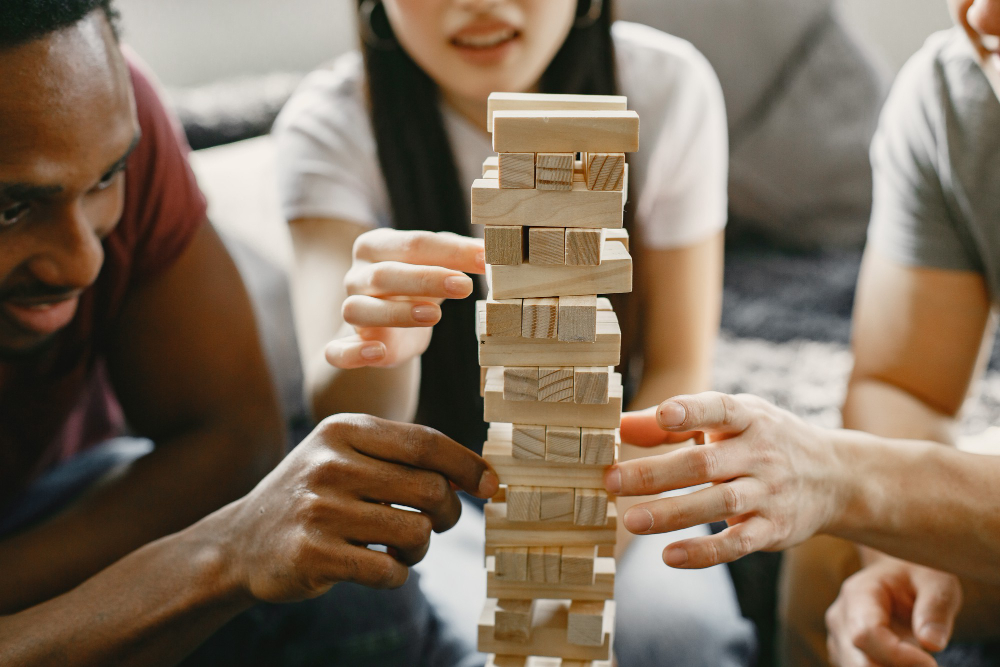
- Kapla tower / spaghetti challenge: frugal engineering to "think with your hands" and work together under time pressure.
- Resolution relay: each pair advances a task, passes the baton, develops process coherence.
- Values & onboarding quiz: excellent for welcoming (onboarding), aligning vocabulary and internal codes.
- Impact" challenge: CSR micro-actions (soft mobility, sorting, digital sobriety) to be accumulated by each team.
- Ideathon: 30-60 min to generate, sort and pitch field improvements.
- Express Olympics: mini physical and cerebral challenges (plan inclusive variants).
- Sales challenge (commercial): product riddles to learn while you play.
- Health" challenge: daily steps, hydration, micro-pauses with team rewards.
- Communicating well" challenge: reformulate, visualize, decide; gamify key soft skills.
Need concrete examples of field events? Event organizers offer blind tests, tug-of-war, races and other cohesion modules calibrated for groups of 60 to 200 people. Get inspired for your own in-house scenarios.
The 6-step method for setting up a group cohesion challenge
- Clarify your common objectives. E.g.: "accelerate product learning", "streamline inter-team communication", "support an impact project". Prioritize 1-2 KPIs (participation, completion, internal NPS).
- Map your group. Size, professions, locations, constraints (schedules, accessibility). Aim for inclusion (alternative formats, progressive difficulty).
- Choose your game mechanics. Rankings (teams), daily challenges, badges, coopetition. Choose 15-minute micro-activities that can be integrated into your daily routine.
- Frame the experience. Announcement rituals, rules page, calendar, roles (captains), symbolic rewards.
- Launch "pilot" (2 weeks). Test with a sample. Measure: registration rate, completion rate, interactions.
- Measure, learn, sustain. Transform one-shots into recurring "shared moments": team rituals, communities of practice, celebrations.
Measuring what matters
- Participation & activation: % registered → % active → % regular.
- Engagement : challenges completed, average time, contributions.
- Relational quality: feedback, positive mentions, perceptions of a climate of trust.
- Operational transfer: ideas implemented, deadlines, incidents avoided.
- Business impact: HR indicators (absenteeism, internal mobility), sales (product knowledge, conversion rate) or learning (certifications).
Why choose OuiLive for your team-building challenge?
- Quick, turnkey launch: intuitive interface, +200 templates to create your own cohesion games in just a few minutes.
- A gamified platform that really engages: 100% mobile, short challenges, rankings, scalable rewards, and a cooperative mechanic that brings people together.
- Measurable results: real-time dashboards, multi-team monitoring, exports.
FAQ
How long does an effective cohesion game last?
From 15 minutes (weekly or daily ritual) to 2 hours (workshop). The key: regularity and alignment with your goals.
Competition or cooperation?
A light competitive spirit can be motivating, but favor team mechanics (shared points, collaborative challenges) to avoid the "win-lose" effect.
Face-to-face, hybrid, remote?
All formats are possible: on-site treasure hunt, digital escape game, asynchronous ideathon. The key is to ensure accessibility and clarity of rules.
What does this have to do with "psychological safety"?
Well-framed games can set benchmarks (listening, right to try) and nurture a climate of trust conducive to learning - a documented factor in team performance.
Sources :
2) RH Performances - 5 tips to encourage team cohesion: rituals, 15-minute stand-ups, managerial levers. Read the article
3) Edmondson, A. (1999) - Psychological Safety and Learning Behavior in Work Teams (Administrative Science Quarterly). DOI / Access
4) Welcome to the Jungle (2022) - Cohesion vs. coherence: a useful distinction for framing your actions. Read the article